


Frozen French Fries Production Process
Frozen French fries are popular in supermarkets, restaurants, fast-food chains, and food distribution markets. With the growing demand for convenient frozen potato products, setting up a frozen French fries production line has become an attractive business opportunity for food manufacturers.
But how are frozen French fries made? What equipment is required for commercial production? A complete frozen French fries production process includes potato washing, peeling, sorting, cutting, starch removal, blanching, dewatering, pre-frying, cooling, quick freezing, and packaging.
This article explains each processing step, introduces the main French fries processing line equipment, and provides technical information to help you select a suitable production solution.
1. What Is the Frozen French Fries Production Process?
The frozen French fries manufacturing process transforms fresh potatoes into uniform, partially fried, and frozen potato sticks.
A typical industrial French fries processing line includes the following steps:
Fresh Potatoes → Washing and Peeling → Sorting → Cutting → Starch Removal → Blanching → Dewatering → Pre-frying → De-oiling and Cooling → IQF Freezing → Weighing and Packaging → Frozen Storage
Each step plays an important role in maintaining the color, shape, texture, and quality of the finished French fries.
2. Complete Frozen French Fries Production Flow
The following is a typical process flow for a commercial frozen French fries production line:
- Potato feeding
- Potato washing and peeling
- Manual or automatic sorting
- French fries cutting
- Surface starch washing
- Hot water blanching
- Surface water removal
- Pre-frying
- De-oiling and cooling
- Individual quick freezing (IQF)
- Automatic weighing and packaging
- Cold storage
The specific process can be adjusted according to potato varieties, finished product specifications, production capacity, and market requirements.
3. Detailed Steps of French Fries Manufacturing
Step 1: Potato Washing and Peeling
Fresh potatoes are first transported to the washing and peeling machine through a feeding conveyor or elevator.
The machine removes soil, stones, and other impurities from potato surfaces. Brush rollers or abrasive rollers help remove potato skins.
A suitable washing and peeling machine can perform both cleaning and peeling operations, reducing manual work and improving processing efficiency.
Recommended equipment:
- Potato washing machine
- Potato peeling machine
- Potato feeding elevator
Step 2: Potato Sorting and Inspection
After washing and peeling, potatoes are transported to a sorting conveyor.
Workers or automatic inspection systems remove rotten potatoes, damaged materials, and potatoes with remaining skin or defects.
Sorting helps maintain consistent product quality and prevents unqualified raw materials from entering the cutting process.
Recommended equipment: Potato sorting and inspection conveyor.
Step 3: Cutting Potatoes into French Fries
Clean potatoes are fed into an industrial French fries cutting machine.
The machine cuts potatoes into uniform strips according to the required dimensions.
Common French fries sizes include:
- 7 × 7 mm
- 9 × 9 mm
- 10 × 10 mm
- 12 × 12 mm
Different cutting blades can be selected according to product requirements.
Uniform cutting is important because it helps fries cook evenly during blanching and frying.
Recommended equipment: Commercial French fries cutting machine.
Step 4: Washing and Removing Surface Starch
After cutting, potato strips enter a washing machine to remove excess surface starch.
This process helps prevent potato strips from sticking together and improves the appearance of finished French fries.
Bubble washing or continuous water washing systems can be selected according to processing capacity.
Water circulation and filtration systems can also be added to reduce water consumption.
Recommended equipment: Bubble washing machine or continuous rinsing machine.
Step 5: Blanching French Fries
Blanching is an important step in the frozen French fries production process.
Potato strips pass through hot water or a steam blanching system. This treatment helps inactivate enzymes, control natural sugars, improve color consistency, and prepare the potato strips for subsequent frying.
The blanching temperature and time depend on potato variety, strip thickness, and finished product requirements.
A preliminary process reference is approximately 70–95°C for 2–5 minutes. Actual settings should be confirmed through production trials.
Some production lines also include a cooling or rinsing stage after blanching to stop further cooking.
Recommended equipment: Continuous hot water blanching machine.
Step 6: Dewatering and Surface Drying
After blanching, potato strips contain excess water.
A centrifugal dewatering machine or vibrating drainage conveyor removes surface water before frying.
An additional air drying system can be installed when necessary.
This step helps reduce oil splashing, improve frying stability, and maintain a consistent product texture.
Recommended equipment:
- Vibrating dewatering machine
- Centrifugal dewatering machine
- Air drying conveyor
Step 7: Pre-frying French Fries
Pre-frying gives potato strips their initial texture and prepares them for freezing and final cooking.
The potato strips enter a continuous industrial fryer, where hot oil partially cooks the product.
A preliminary frying temperature may be around 160–180°C, with the actual temperature and residence time determined by strip dimensions, oil circulation, and the desired pre-fried condition.
A continuous fryer offers stable temperature control and consistent processing.
Recommended equipment: Continuous French fries frying machine.
Step 8: De-oiling and Cooling
After pre-frying, French fries pass through a vibrating or centrifugal de-oiling system to remove excess surface oil.
The fries are then cooled before entering the freezing system.
Cooling helps reduce the product temperature and prepares it for efficient quick freezing.
Recommended equipment:
- Vibrating de-oiling machine
- Cooling conveyor
Step 9: Individual Quick Freezing (IQF)
Quick freezing is essential for producing frozen French fries.
The cooled, pre-fried potato strips enter an IQF tunnel freezer or another suitable industrial freezing system.
The fries are rapidly frozen to help preserve their shape, texture, and product quality while minimizing the formation of large ice crystals.
Individual quick freezing also helps prevent potato strips from sticking together.
The freezing conditions should be designed according to product size, inlet temperature, loading rate, and required final core temperature.
For many frozen food applications, the target final product core temperature is -18°C or below, subject to the applicable food safety and storage requirements.
Recommended equipment:
- IQF tunnel freezer
- Refrigeration system
- Frozen product conveying system
Step 10: Weighing and Packaging
After quick freezing, frozen French fries are conveyed to an automatic weighing and packaging machine.
Common packaging options include:
- 500 g retail bags
- 1 kg retail bags
- 2.5 kg foodservice bags
- 5 kg bulk packages
- 10 kg commercial packages
Packaging equipment can be selected according to bag size, weighing accuracy, packaging material, and production capacity.
The finished products are transferred to cold storage for frozen distribution.
Recommended equipment:
- Automatic weighing machine
- Vertical form-fill-seal packaging machine
- Metal detector
- Finished product cold storage
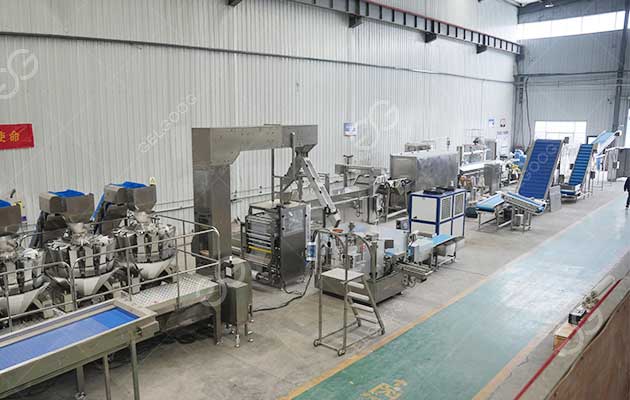
4. French Fries Processing Line Equipment and Technical Parameters
A complete French fries processing line consists of multiple machines connected by conveyors.
The following equipment is commonly used:
| Equipment | Main Function |
|---|---|
| Potato washing and peeling machine | Remove dirt and potato skins |
| Sorting conveyor | Remove damaged and unqualified potatoes |
| French fries cutting machine | Cut potatoes into uniform strips |
| Bubble washing machine | Remove surface starch |
| Blanching machine | Inactivate enzymes and help maintain color |
| Dewatering machine | Remove excess surface water |
| Continuous fryer | Pre-fry potato strips |
| De-oiling machine | Remove excess oil |
| Cooling conveyor | Cool fries before freezing |
| IQF freezer | Rapidly freeze potato strips |
| Weighing and packaging machine | Pack finished frozen French fries |
Technical Parameters of French Fries Processing Equipment
The following parameters are published on GELGOOG's existing equipment pages and can be used as preliminary reference data.
| Equipment | Power | Capacity | Size |
|---|---|---|---|
| Potato washer and peeler | 0.75 kW | 200 kg/h | 650 × 550 × 800 mm |
| Potato cutter | 1.1 kW | 600 kg/h | 950 × 900 × 1,000 mm |
| Blanching machine | 9 kW | 60 kg/h | 700 × 700 × 900 mm |
| Dewatering machine | 1.5 kW | 200 kg/h | 900 × 500 × 800 mm |
| Potato fryer | 12 kW | 20 kg/h | 700 × 700 × 900 mm |
| De-oiling machine | 1.1 kW | 200 kg/h | 900 × 500 × 800 mm |
| Flavoring machine | 1.1 kW | 200 kg/h | 1,100 × 800 × 1,300 mm |
Note: These are published specifications for a small-scale potato processing equipment configuration, not a balanced frozen French fries production line. The capacity of each machine must be matched when designing a complete production system. An IQF freezer and industrial packaging system require separate selection and technical confirmation.
GELGOOG can customize equipment according to the required processing capacity and finished product specifications.
5. French Fries Production Line Capacity and Customization
Different food manufacturers have different production requirements.
A small French fries business may need a semi-automatic processing line, while a large frozen food factory may require a continuous automatic production system.
GELGOOG provides French fries processing equipment and customized production line solutions.
The published product information includes a 100 kg/h potato processing line, while the original article also describes equipment options ranging from 50 to 1,000 kg/h.
The final production capacity depends on the complete line configuration, including washing, cutting, blanching, frying, freezing, and packaging.
Before selecting equipment, consider:
- Required hourly output
- Potato varieties and raw material size
- French fries cutting dimensions
- Pre-frying or fully frying requirements
- Freezing capacity and final product temperature
- Packaging sizes and packaging speed
- Factory layout and available utilities
6. French Fries Processing Line Project and Factory Application
A commercial French fries processing line should be designed according to the customer's factory space, production target, and market requirements.
The complete production area usually includes:
-
Raw potato receiving and storage area.
-
Washing, peeling, and sorting area.
-
Cutting and blanching area.
-
Dewatering and pre-frying area.
-
Cooling and quick-freezing area.
-
Weighing and packaging area.
-
Finished product cold storage.
The equipment layout should ensure smooth material movement and separate raw potato handling from finished product packaging.
For frozen French fries factories, hygienic zoning, water drainage, temperature control, and cold chain management are also important.
GELGOOG can provide equipment selection, production line layout, and customized processing solutions according to customer requirements.
7. Frequently Asked Questions About Frozen French Fries Production
Q1: What is the frozen French fries production process?
The typical process includes potato washing, peeling, sorting, cutting, starch washing, blanching, dewatering, pre-frying, de-oiling, cooling, quick freezing, and packaging.
Q2: What machines are needed for a French fries processing line?
A complete line generally requires potato washing and peeling machines, sorting conveyors, French fries cutters, washing machines, blanching machines, dewatering equipment, continuous fryers, de-oiling systems, IQF freezers, and packaging machines.
Q3: Why are potatoes blanched before frying?
Blanching helps inactivate enzymes, control reducing sugars, improve color consistency, and prepare potato strips for frying.
Q4: What is the purpose of quick freezing in French fries production?
Quick freezing helps preserve product quality, reduce the formation of large ice crystals, and keep individual fries from sticking together.
Q5: What is the suitable frying temperature for frozen French fries?
A preliminary pre-frying temperature is commonly around 160–180°C. The actual temperature and frying time depend on potato size, moisture content, and the desired finished product.
Q6: Can one production line produce different sizes of French fries?
Yes. By changing cutting blades, the production line can make different French fries sizes, such as 7 × 7 mm, 9 × 9 mm, and 10 × 10 mm. The cutting machine should be selected according to the required product specifications.
Q7: What is the difference between fresh French fries and frozen French fries?
Fresh French fries are usually washed, peeled, cut, and packed for short-term use or distribution. Frozen French fries require additional processing, such as blanching, pre-frying, quick freezing, and frozen packaging.
Q8: Can GELGOOG provide a complete automatic French fries processing line?
Yes. GELGOOG provides French fries processing machines and customized production line solutions. The configuration can include washing, peeling, cutting, blanching, dewatering, frying, de-oiling, quick freezing, and packaging equipment.
Get a Customized French Fries Processing Line Solution
Are you planning to start a frozen French fries manufacturing business or upgrade your existing potato processing factory?
GELGOOG provides industrial French fries processing equipment and customized production line solutions for different production capacities.
Send us your requirements, including:
- Raw material: Fresh potatoes
- Required capacity: kg/h or tons/day
- French fries size: 7 × 7 mm, 9 × 9 mm, 10 × 10 mm, etc.
- Product type: Fresh, pre-fried, or frozen French fries
- Packaging requirements: 500 g, 1 kg, 2.5 kg, or bulk packages
Our team can recommend a suitable French fries processing line and provide equipment details, production flow, and a quotation.
Contact GELGOOG
Email: skena@gelgoog.com
WhatsApp: +86 185 9561 3260
Website: www.fruitok.com


 E_mail
 contact
 Whatsapp
 TOP